
Britain has spent the summer of 2026 breaking heat records, with drought bulletins across every English region. So why is a flood recovery consultancy writing about drought? Because baked, compacted ground sheds rain instead of soaking it — and that is how many of Britain's worst flash floods begin.
Published July 2026 · A RISE update · 5–7 minute read
Britain has spent the summer of 2026 breaking records nobody wanted. By mid-July the Met Office had logged more days above 30°C than in the fabled summer of 1976. We are on our third heatwave. Hosepipe bans have spread across multiple water companies, and the Environment Agency's drought bulletins report drier-than-average soils in every English region, with river flows and groundwater declining at nearly all monitored sites.
So why is a flood recovery consultancy writing about drought?
Because drought is how many of Britain's worst flash floods begin.
Healthy soil behaves like a sponge. It absorbs rainfall, holds it, releases it slowly into watercourses. But weeks of heat do two things to that sponge. First, they bake it hard — compacting the surface until it behaves more like concrete than earth. Second, prolonged drying can make soil genuinely water-repellent (hydrophobic): the first rain beads and runs rather than soaking in.
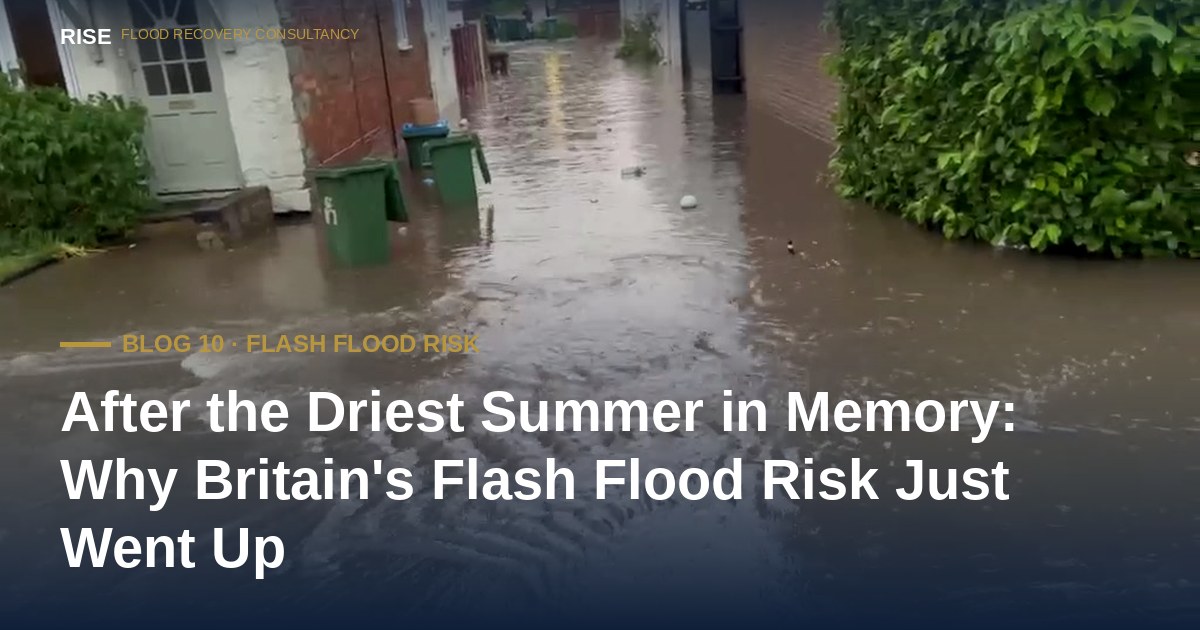
Now put a typical British autumn on top of that. The jet stream shifts, Atlantic systems return, and the first serious rain of the season often arrives as intense, concentrated downpours — sometimes a month's rain in a day. On absorbent ground, much of that would disappear into the soil. On this year's ground, it will run: off fields, down lanes, along roads, into whichever street, dip or doorstep sits lowest. This is surface water flooding — and it can devastate homes that have never seen a river.
The pattern is not theoretical. Britain has seen it repeatedly: parched summers followed by autumn deluges that overwhelmed drains and turned high streets into rivers. What is different now is the intensity at both ends. Climate change is loading the dice toward hotter, drier summers and heavier individual rainfall events. The ground swings between extremes; the Victorian drainage under our streets was designed for neither.
Three things, in the RISE Three-R framing.
Resistance — the simple physical measures: airbrick covers, door barriers, checking that the road gullies on your street are clear. After a summer like this they are full of dust, leaves and debris, and council cleaning cycles are long.
Resilience — if you are doing any building work, make choices that limit damage if water ever enters.
Recoverability — know your rights before you need them, including your council's legal duty under Section 19 of the Flood and Water Management Act 2010 to investigate significant flooding and act on what it finds.
The water that fell this winter will not care whether we prepared. But whether it crosses your threshold — and what happens if it does — is still substantially in your hands, this month, while the sun is shining.
If flooding is your problem, or your fear, start with the free Complete Flood Recovery Guide — or call 07391 151719 for a free consultation.
Sources and further reading: Met Office, summer 2026 temperature records and heatwave reporting; Environment Agency, drought and water situation bulletins (summer 2026); Environment Agency, National Assessment of Flood and Coastal Erosion Risk in England 2024 (NaFRA2, published January 2025). On the mechanics of dry, water-repellent soils and flash flood generation, see general soil-science and hydrology literature on soil hydrophobicity and infiltration.
Live data from the Environment Agency, refreshed every 15 minutes.
No obligation. No jargon. By the end of the call you will know exactly where you stand — whether you engage RISE or not.
Available 24 hours, 365 days No callback RISE directly
Help us focus future content
RISE is researching gaps in publicly available flood recovery information. If you have 90 seconds, your responses help us understand what homeowners actually struggle to find clear answers on — and shape what we write next.
Take the 90-second survey →