
Enter your details below and the complete guide unlocks immediately on this page — plus a downloadable PDF copy to keep.
If your home has just flooded, or you’re staring down a forecast that says it might, you don’t need a lecture on climate statistics right now. You need to know what to do in the next hour, the next week, and the next year — and you need someone straight with you about the things insurers, contractors and even well-meaning guides tend to gloss over.
That’s what this guide is for. It’s built from real recovery experience, not just policy documents: the insurance cover that looks generous on paper and isn’t, the surveyor who’s supposed to be on your side and isn’t always, the statutory process almost nobody tells homeowners exists. Read it in order, or jump straight to the part that matches where you are right now.
Flooding is no longer a rare event confined to a handful of well-known trouble spots, anywhere in the UK. In England alone, the Environment Agency’s most recent national assessment, published in December 2024, found that 6.3 million properties now sit in areas at risk of flooding from rivers, the sea, or surface water — nearly half of that risk driven by surface water alone. Factor in what a changing climate is likely to bring over the coming decades, and that figure could rise to around 8 million properties, or roughly one in four homes in England, by the middle of this century.
Scotland, Wales and Northern Ireland face the same fundamental pressures, even though each nation manages flood risk through its own legal and institutional framework. Surface water flooding, more frequent and intense rainfall, and ageing drainage infrastructure are not an England-specific problem — they’re a UK-wide one, and a growing one. Where the position genuinely differs between nations — the law governing flood investigations, for instance, or which body issues warnings — this guide says so explicitly, rather than assuming England’s rules apply everywhere.
Those numbers matter because flooding rarely behaves the way people expect. It doesn’t only affect homes next to rivers, and it doesn’t only happen during dramatic winter storms. Surface water flooding — where drainage simply can’t cope with the volume of rain falling in a short space of time — can affect a property miles from any watercourse, often with almost no warning at all.
This guide sets out, in plain terms, what you need to know before, during and after a flood: how to understand your own risk, what preparation genuinely helps, how insurance and recovery actually work in practice, and — because it’s a subject that gets almost no attention anywhere else — what a Section 19 flood investigation is (and what the equivalent looks like in Scotland and Northern Ireland), and why it matters far beyond your own front door.
We’ve built this guide from independent research into current UK flood policy, insurance schemes, technical standards and statutory processes, checked against primary sources rather than assumption. Where facts have changed recently — and several genuinely have — we’ve reflected the current position rather than the version that’s been circulating for years.
Most people picture a flood as a river bursting its banks. In reality, water can enter a home through several distinct routes, often in combination:
Many serious flood events are actually a combination of several of these sources acting together, which is one reason flood damage can be more extensive, and harder to explain to an insurer, than a single cause would suggest.
Government flood risk checking tools are the sensible starting point, and they’re free:
It’s worth being realistic about what these tools actually tell you. They give a general picture for an area, built from national modelling — they are not a property-specific assessment, and groundwater and some local surface water risks aren’t always fully captured. In England and Wales, your Lead Local Flood Authority (LLFA) — usually your county or unitary council — holds more localised knowledge and is required to prepare and maintain a local flood risk management strategy. In Scotland, this local role sits with your council working alongside the Scottish Environment Protection Agency (SEPA); in Northern Ireland, it’s DfI Rivers, the statutory drainage and flood defence authority.
For a genuinely detailed, property-specific risk assessment, a chartered surveyor with flood expertise can inspect the property itself and factor in local drainage, groundwater behaviour, and construction type in a way no map can.
Flood history should be part of any property purchase decision, not an afterthought. A seller should be asked directly whether the property has flooded before, but sellers aren’t always forthcoming, and standard conveyancing searches have real limits — a solicitor’s desktop search is not the same thing as a chartered surveyor’s physical inspection of the property and its actual flood history.
This matters for more than peace of mind. Flood risk affects insurability, and insurability affects both mortgageability and resale value. If you’re buying a property that already has flood resilience measures fitted — flood doors, air brick covers, non-return valves and the like — find out how they work and what maintenance they need, since most manufacturers specify maintenance schedules that affect whether the measures remain valid.
Three separate tools are worth having bookmarked, because they serve slightly different purposes:
In England, the Environment Agency issues four levels of notification, and it’s worth knowing exactly what each one means, because the right response is different at each stage:
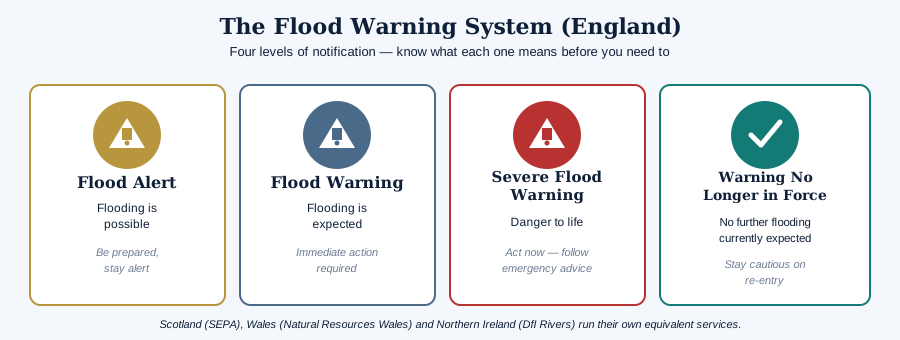
| Alert | What it means |
|---|---|
| Flood Alert | Flooding is possible — be prepared |
| Flood Warning | Flooding is expected — immediate action required |
| Severe Flood Warning | Severe flooding, danger to life |
| Warning no longer in force | No further flooding currently expected in your area |
Scotland, Wales and Northern Ireland each run their own equivalent service, worth signing up to directly rather than assuming the English system covers you:
A flood plan is one of those things everyone intends to make and few people finish. It doesn’t need to be complicated: what to move and where, who in the household needs particular help, where to shut off utilities, and key contact numbers. The Flood Hub provides a household flood plan template with helpful prompts already built in. Whichever you use, the plan is only useful if it’s somewhere you can actually find it in a hurry.
If your property carries meaningful flood risk, it’s worth understanding property flood resilience — measures that make a building’s fabric and services more robust, and easier to clean, dry and put back together, if water does get in.
Two technical standards now govern this area, and it’s worth knowing both exist because most consumer guidance still only references the older one:
Whatever you decide to install, get it properly specified and installed — a chartered surveyor experienced in flood-related work, or a specialist PFR contractor, can advise on flood risk, recommend suitable measures, supervise the work, and produce the documentation insurers and mortgage lenders may later ask for.
If flooding is happening or clearly about to happen, prioritise people over possessions.
Only return to a flooded home once it’s genuinely safe to do so, and follow the advice of the emergency services and your insurer on timing.
Going back to a flooded home for the first time is both physically and emotionally difficult. Beyond the mud and water, expect it to be smelly — particularly where sewage has mixed with floodwater — and be ready for unfamiliar hazards that weren’t there before.
Work through the property room by room rather than starting to clear up straight away:
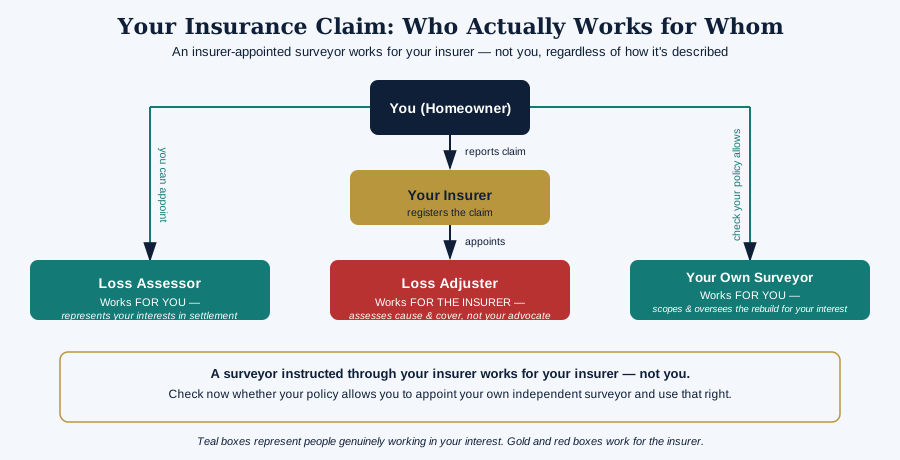
Contact your insurer as soon as you reasonably can — most run 24-hour emergency lines specifically for this. Once your claim is registered, your insurer will typically appoint a loss adjuster, whose job is to establish the cause of the damage and assess how much of it is covered by your policy.
You can, if you choose, appoint an independent loss assessor to represent your interests directly through this process and help you achieve the best possible settlement — this is different from a loss adjuster, who works for the insurer, not for you.
You may also need a chartered building surveyor at some point, to assess the damage independently, advise on repair, and advise on how the property can be made more resilient to future flooding. This is one of the most consequential decisions in the entire recovery process: a surveyor instructed and appointed through your insurer works for your insurer, not for you — regardless of how that surveyor is described, and regardless of any assurance that they’ll act “independently.” Independence in that context means independence from bias in their professional judgement; it does not mean they represent your interests over the insurer’s.
Check your policy now for whether it allows you to appoint your own surveyor, separate from anyone instructed by your insurer, and use that right if it exists. A surveyor working directly for you is the single biggest factor in making sure a rebuild is scoped correctly and carried out properly from the outset.
Insurers will typically need: your policy number, date of birth and contact details, the date the flood occurred, a note of which areas of the property were affected, photos of the damage, and invoices for any temporary repairs or previous maintenance work.
Buildings and contents cover are sometimes with different insurers, so check both policies separately. If a car was affected, that’s a separate claim to your motor insurer.
Make sure your insurer knows this from the outset. Standard flood repair procedures can be genuinely damaging to historic fabric, and can breach listed building regulations if carried out without proper consent. You may need to involve the Conservation Officer at your local council, or seek advice from the relevant national heritage body — Historic England, Cadw in Wales, or Historic Environment Scotland — alongside the Society for the Protection of Ancient Buildings, which operates across the UK.
If you rent, contact your landlord or housing association as soon as possible — they’re likely responsible for insuring the building itself, and may be able to help with temporary accommodation while repairs are underway.
Get a notebook specifically for this process and use it consistently. Every call with an insurer, loss adjuster or contractor — date, name, what was agreed, any advice given — noted down the same day. Keep copies of every letter and email you send about the claim too.
Ask your insurer about this early. Reasonable costs are usually covered up to a policy limit, and insurers need to know if anyone in the household needs priority consideration. If a wider area has flooded at the same time as your home, expect competition for suitable local housing.
Alternative accommodation cover is typically expressed as a single lump sum — commonly somewhere around £25,000 — and at first glance that sounds like more than enough to cover a family’s rent while their home is rebuilt. In practice, that figure very rarely covers rent alone. It has to stretch to cover:
All of this comes out of the same lump sum. Once it’s spread across those costs, a figure that looked generous on paper can realistically fund only three to four months of actual accommodation — while a genuine flood rebuild commonly takes around a year, sometimes longer. That leaves a substantial gap: many months where a household is still covering rent, utilities and council tax on temporary accommodation, while simultaneously still paying the mortgage, council tax, and standing utility charges on their own, uninhabitable property.
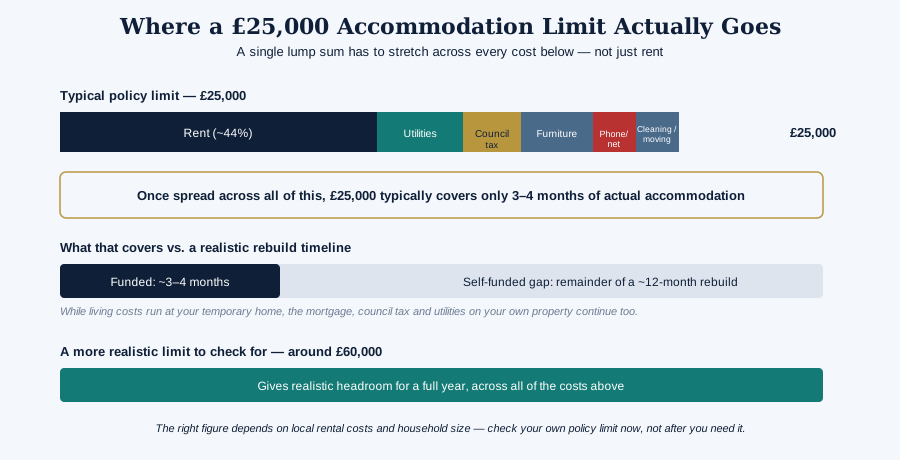
The practical lesson: check the actual alternative accommodation limit on your policy now, not after you need it. A limit closer to £60,000 gives far more realistic headroom — though the right figure for your household depends on local rental costs and family size.
It’s also worth remembering this isn’t a flood-specific problem. The same underinsurance risk applies to any major peril requiring an extended rebuild — a serious fire, for instance, brings fire damage, smoke damage and water damage from firefighting efforts together, often with an even longer repair timeline than a flood.
Amid everything else, it’s easy to forget the practical admin of actually living somewhere else for months. Setting up mail redirection through Royal Mail is worth doing early — with a rebuild potentially running the best part of a year, important post needs to reliably reach you at your temporary address.
Ask your insurance company whether they’ll help fund repairs that also improve your property’s future flood resilience. This is the purpose of Build Back Better, a Flood Re-led scheme that a number of major insurers — including Ageas, Aviva, NFU Mutual, Lloyds Banking Group and LV= General Insurance — now participate in.
Where it applies, Build Back Better allows for reimbursement of up to £10,000 towards property flood resilience measures, over and above the cost of repairing the actual flood damage. Each insurer sets its own eligibility criteria, so what qualifies with one provider may differ from another.
Ask whether they follow recognised codes of practice for flood damage restoration — currently the PCA/BDMA-recognised code for the recovery of water-damaged buildings, alongside the newer CIRIA C790 and BS 85500:2025 standards for resilient repair.
You’ll be responsible for covering the cost of the damage yourself, but that doesn’t mean there’s no help available — contact your local authority to ask about emergency grants or hardship funds, and check whether any local or national charities are supporting flood-affected households in your area.
Living upstairs while repairs happen is sometimes possible for a few days immediately after a flood, but it becomes genuinely difficult once cleaning, drying and rebuilding work starts in earnest.
A property at risk of flooding, or with a flood history, will typically be worth less than an equivalent property without that history — mainly because it may become harder to insure, and because a serious flood can render a property temporarily uninhabitable. Chartered valuation surveyors are required to factor flood risk into any valuation. Investing in genuine flood resilience measures, properly installed and documented, is one of the few things a homeowner can do to actively limit this impact.
Flood Re is a joint initiative between the UK insurance industry and government, launched in April 2016, designed to keep home insurance affordable for households in high flood-risk areas — broadly, those with more than a 1-in-75 annual chance of flooding, in properties built before 2009. It’s a genuinely UK-wide scheme: eligible properties in England, Scotland, Wales and Northern Ireland can all be covered (the Isle of Man and Channel Islands are excluded).
Here’s how it actually works: you buy your home insurance in the ordinary way. If your property is eligible, your insurer can choose to pass (“cede”) the flood risk element of your policy to Flood Re. Flood Re charges the insurer a premium based on your property’s council tax band — not the property’s individual flood risk — which is what allows premiums to stay affordable. If you later make a valid flood claim, your own insurer pays it as normal, and Flood Re then reimburses the insurer from its own fund. The scheme is funded entirely by a levy on the UK insurance industry (currently around £160 million a year) plus those per-policy premiums, with a fixed £250 excess per claim — it carries no cost to the taxpayer.
Alongside Build Back Better, Flood Re has been developing the concept of a Flood Performance Certificate (FPC) — similar in spirit to an Energy Performance Certificate, but scoring how well a property’s various flood resilience features work together. A working prototype is expected to be ready for wider piloting during 2026. It isn’t yet a live consumer product, but it’s a genuine sign of where flood insurance and property resilience assessment are heading.
Recovery from a serious flood is measured in months, not weeks, and sometimes stretches into years for the most severely affected properties. A building needs to be genuinely dried out before repair and redecoration can begin — do this too early and damp and mould can undo the work entirely.
The most common drying method uses industrial dehumidifying equipment, which typically takes around four to six weeks to complete. Faster drying techniques — including trailer-mounted rapid or heat-drying systems — have developed in recent years and are now used by some insurers.
If flooding has affected a wide area, tradespeople will be in short supply, and this is exactly when opportunistic “rogue traders” tend to appear. Some builders working in flood recovery are, frankly, unethical — cutting corners on work that’s difficult to inspect once it’s covered over.
Proper vetting of contractors should go through your own independent surveyor, not be handled ad hoc. A surveyor experienced in flood rebuilds should hold a list of contractors they already know are capable of this specific type of work.
Once work begins, expect the unexpected. Opening up a wall or lifting a floor very often reveals problems that had nothing to do with the flood itself. This is normal. What matters is that anything found is properly identified, documented and fixed at the time — not quietly plastered over.
Insist on regular, structured oversight rather than occasional updates. Monthly meetings with your surveyor, with a proper progress report each time, keep a long, disruptive rebuild honest and on track.
Beyond surveyor-vetted contractors, always independently check a contractor’s trade body membership is currently valid, and ask for references you can actually follow up yourself.
Almost none of the general flood recovery guidance available to homeowners mentions this process, which is unfortunate, because it can matter more to your long-term flood risk than anything covered by an insurance claim. The specific legal mechanism differs depending on which UK nation you’re in, so this section covers each in turn.
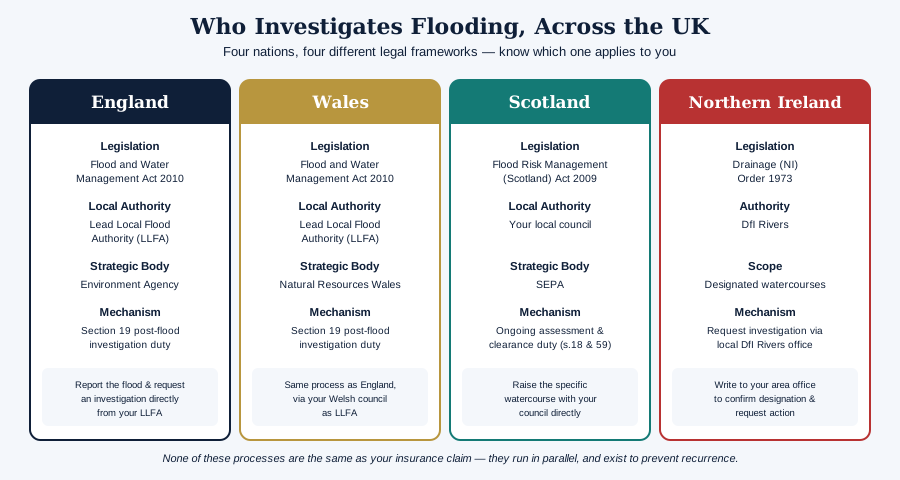
Under Section 19 of the Flood and Water Management Act 2010, your Lead Local Flood Authority has a duty to investigate flooding in its area, to the extent it considers necessary or appropriate. Where that duty is triggered, the LLFA is required to identify which flood risk management authorities had relevant functions, and to publish the results of its investigation. The Act applies in the same way in Wales as in England, with Natural Resources Wales providing the strategic oversight role.
In plain terms: this isn’t about your insurance claim, and it isn’t about compensation. It’s a formal, published record of what actually caused a flood, which authorities have relevant responsibilities, and what — if anything — is being done about it.
Why this matters even if you’re fully insured. An insurance claim deals with the damage to your own property. It says nothing about why the flood happened in the first place, and does nothing to prevent it happening again. A Section 19 investigation is the mechanism that can actually surface a blocked culvert, an undersized drain, or a maintenance gap between different authorities.
What triggers an investigation, and what doesn’t. Each LLFA sets its own local criteria — often based on the number of properties affected and the frequency of flooding in the area. Not every flood will automatically trigger an investigation without a homeowner formally requesting one.
What you can do:
This section covers the essentials, but if you want the full depth — case archetypes, exactly what makes an investigation succeed or fail, and how to write a request letter that actually gets engaged with — our Section 19 Reference Manual is a free, dedicated deep dive into this specific process for England.
Scotland doesn’t use Section 19 — flooding there is governed by the Flood Risk Management (Scotland) Act 2009. Rather than a duty to investigate a specific flood after it’s happened, the Act places an ongoing duty on local authorities (sections 18 and 59) to assess bodies of water for flood risk, and to carry out a schedule of clearance and repair works where this would substantially reduce risk. SEPA works alongside local authorities and Scottish Water as the strategic body.
The practical implication: rather than requesting a post-event investigation into a single flood, the more effective route is to formally raise the specific body of water or drainage issue with your local authority, referencing its duty under sections 18 and 59.
DfI Rivers, an agency of the Department for Infrastructure, is the statutory drainage and flood defence authority under the Drainage (Northern Ireland) Order 1973. Its responsibilities apply to “designated” watercourses, while non-designated watercourses remain the maintenance responsibility of the riparian landowner.
If you’ve been flooded in Northern Ireland, you can write to your local DfI Rivers area office to ask whether the watercourse involved is designated, and to request investigation of a blockage or maintenance failure. DfI Rivers does not accept liability for damage caused by a watercourse overflowing — that remains a matter for your own insurer — but establishing the cause is still valuable for preventing recurrence.
Whichever nation you’re in, the same underlying principle applies: your insurance claim and the question of why the flood happened in the first place are two entirely separate processes. Pursuing only the insurance claim gets your own property repaired. Pursuing the statutory investigation route as well is what actually gives you a chance of the same flood not happening again.
The weeks and months following a flood are frequently described by those who’ve lived through it in terms close to bereavement. Sadness, grief, anger and exhaustion are all normal reactions to what is, genuinely, an abnormal and disruptive event.
Practical steps that genuinely help:
Keep children away from standing floodwater, and away from gardens or patios until the area has been properly cleaned and confirmed safe. Older adults and anyone with additional care needs may find both the disruption and the physical demands of recovery particularly difficult.
Flood-affected areas unfortunately attract opportunists who pose as water company officials, council representatives, or insurance assessors to gain access to vulnerable households. Always ask for identification, and if you have any doubt at all, don’t let someone in.
Recovery genuinely does take time, and everyone in a household is likely to be feeling the strain simultaneously. Taking deliberate time away from the recovery process itself, even briefly, tends to help.
Guides like this can end up answering everything except the blunt question someone actually has at 11pm, three days into a flood. Here are the ones we hear most, answered directly.
Generally, no — but you need to check your specific policy wording, since some do require you to use an approved contractor for certain works. You’re entitled to ask questions, request an independent surveyor if your policy allows it, and check reviews before agreeing. Being proposed a contractor is not the same as that contractor being vetted for your interests — see Part Seven.
You’re not alone in this, and it’s one of the most common places recovery genuinely breaks down financially. The first step is establishing exactly how big the gap is likely to be, as early as possible.
Not necessarily — but the strength of your case depends heavily on the evidence you kept at the time. If you didn’t document things as thoroughly as you’d like, it’s still worth asking your LLFA what’s possible; a weaker case is still better pursued than not pursued at all.
No. If you disagree with a decision, you can challenge it directly with your insurer first, and if that doesn’t resolve things, the Financial Ombudsman Service exists specifically to review disputes like this independently.
Yes, genuinely. A serious flood rebuild commonly runs close to a year, and delays compound at almost every stage. It doesn’t mean something has gone wrong with your specific claim — it means the recovery timeline nobody warned you about at the start is the real one.
That’s exactly what we’re here for. If you’d rather talk through your specific situation than work through a guide alone, get in touch and we’ll help you figure out the right next step.
This guide reflects our own independent research into current UK flood policy, insurance arrangements and statutory processes across England, Scotland, Wales and Northern Ireland. It is intended as general guidance rather than advice on your specific circumstances, and does not replace advice from your insurer, a qualified surveyor, or the relevant flood authority in your nation. Facts and figures were verified against primary sources at the time of writing; flood policy — particularly around Flood Re — is subject to ongoing review.
No obligation. No jargon. By the end of the call you will know exactly where you stand — whether you engage RISE or not.
Available 24 hours, 365 days No callback RISE directly
Help us focus future content
RISE is researching gaps in publicly available flood recovery information. If you have 90 seconds, your responses help us understand what homeowners actually struggle to find clear answers on — and shape what we write next.
Take the 90-second survey →We use cookies to improve your experience. Privacy Policy