
Winter is coming
to dry ground

A record-breaking summer has left English soils drier than average in every region — and dry, compacted ground sheds heavy rain instead of absorbing it. Preparation is not sandbags and dread. It is a sequence of unglamorous, mostly free actions, taken while the weather is still kind. Here is the RISE Three-R checklist.
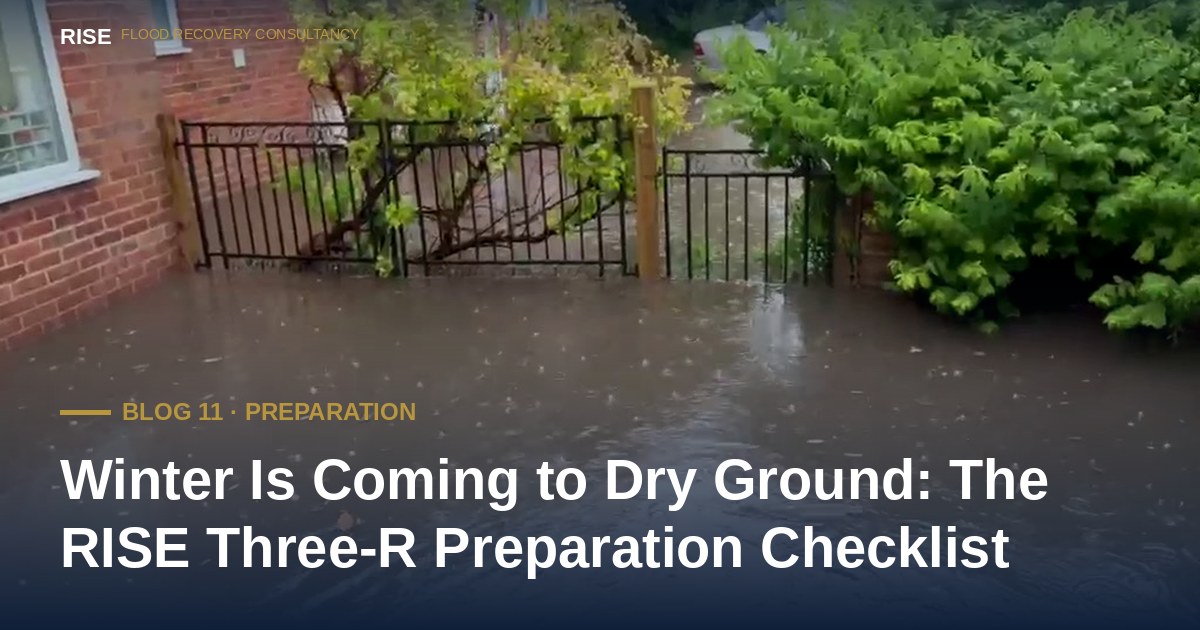
Winter flood preparation checklist

Published July 2026  ·  A RISE update  ·  6–8 minute read

Every October, the same story writes itself somewhere in England: the first big storm of autumn, a month's rain in thirty-six hours, and a street of families discovering that "it's never flooded here" is a statement about the past, not the future. This year the setup is sharper than usual — a record-breaking summer has left English soils drier than average in every region, and dry, compacted ground sheds heavy rain instead of absorbing it.

Preparation is not about sandbags in the hallway and dread. It is a sequence of unglamorous, mostly free actions, taken while the weather is still kind. Here is the RISE checklist, organised by the Three-R Method.

None of this stops the rain. All of it changes what the rain costs you.

R1Resistance: keep the water out

  • Walk your street during or just after the next heavy shower. Watch where water gathers and which way it moves. That flow path is your early warning map.
  • Photograph the road gullies (drain grates) near your home. If they are blocked, report them to your council in writing and keep the email — that paper trail matters later.
  • Fit airbrick covers (minutes, pounds) and consider door barriers for any opening that has let water near before.
  • If your property drains could back-flow, ask a plumber about non-return valves.
  • Clear your own gutters and surface drains before the leaves come down, not after.

R2Resilience: limit the damage if it gets in

  • Know your home's lowest entry points and what you would move, and where, with one hour's warning.
  • Store irreplaceable documents and photos high, or digitise them this month.
  • If you are renovating anyway: resilient plaster, raised sockets, hard flooring. If you are rebuilding after a flood, ask your insurer about Build Back Better funding — up to £10,000 exists for exactly this, and most homeowners are never told.

R3Recoverability: get your paperwork ready before you need it

  • Check your insurance schedule today: is flood explicitly covered, what is the excess, and is the rebuild value realistic?
  • Sign up for Environment Agency flood warnings for your postcode (free, takes two minutes).
  • Photograph every room of your home this month. Dated "before" photos are quiet gold in any future claim.
  • Read the First 72 Hours guide now, calmly, so the knowledge is already in you if the worst happens.
  • Know the phrase "Section 19". If significant flooding ever hits your area, your Lead Local Flood Authority has a legal duty to investigate. That investigation — pushed properly — is how flooded communities get real defences instead of sympathy. It is how RISE's own story ended in £2 million of council-funded infrastructure.
Why this checklist exists now, specifically After the driest summer in memory, the coming autumn's first storms will meet unusually dry, compacted ground that sheds water rather than absorbing it. That raises the risk of surface water flooding — the kind that reaches streets with no river in sight. If you want the reasoning behind that in full, read our companion piece, After the Driest Summer in Memory: Why Britain's Flash Flood Risk Just Went Up.

None of this stops the rain. All of it changes what the rain costs you.

If your home has flooded before and you want to know exactly where you stand with your council, the RISE Section 19 Case Assessment analyses your case against your authority's legal obligations — £250, delivered to your inbox. And if water is rising as you read this: 07391 151719. You will reach RISE directly.


About the author. RISE Flood Recovery Consultancy was founded by a Buckinghamshire homeowner who experienced two major floods firsthand — in June 2023 and September 2024 — and managed both recoveries independently. Sustained engagement through Section 19 of the Flood and Water Management Act 2010 secured over £2 million in council-funded infrastructure works. RISE works exclusively for homeowners — never for insurers, never for contractors.

Sources and further reading: Met Office, summer 2026 temperature records; Environment Agency, drought and water situation bulletins (summer 2026) and flood warning service (gov.uk); Flood Re, Build Back Better initiative. See also the companion RISE article on dry ground and flash flood risk.

Current Conditions

Current flood conditions across England

Live data from the Environment Agency, refreshed every 15 minutes.

Get Started

Free 30-minute consultation

No obligation. No jargon. By the end of the call you will know exactly where you stand — whether you engage RISE or not.

Available 24 hours, 365 days    No callback    RISE directly

Help us focus future content

Was this article useful?

RISE is researching gaps in publicly available flood recovery information. If you have 90 seconds, your responses help us understand what homeowners actually struggle to find clear answers on — and shape what we write next.

Take the 90-second survey →